

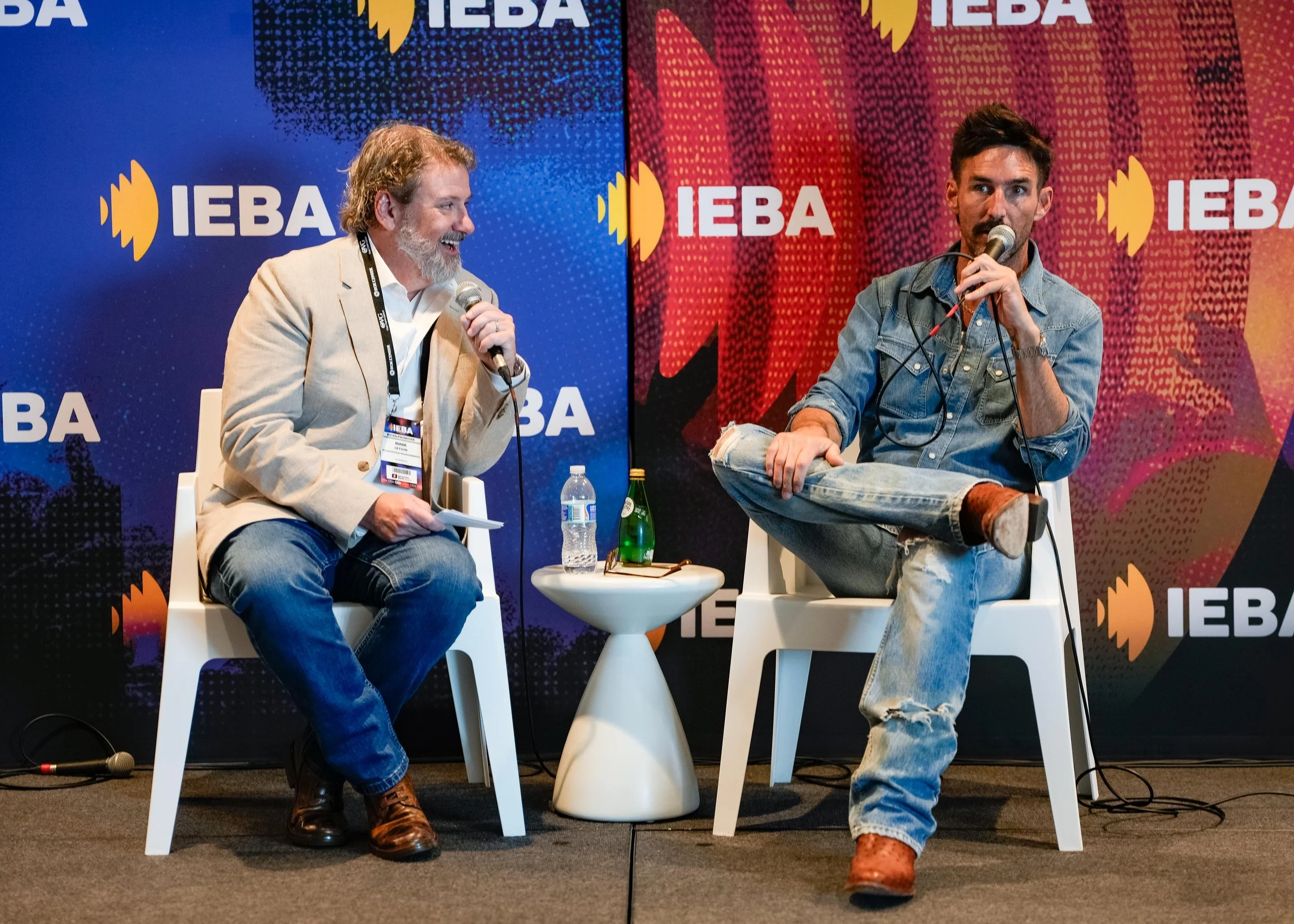
Moderated by: Mark Letson, East Coast Entertainment
Speaker: Jake Owen
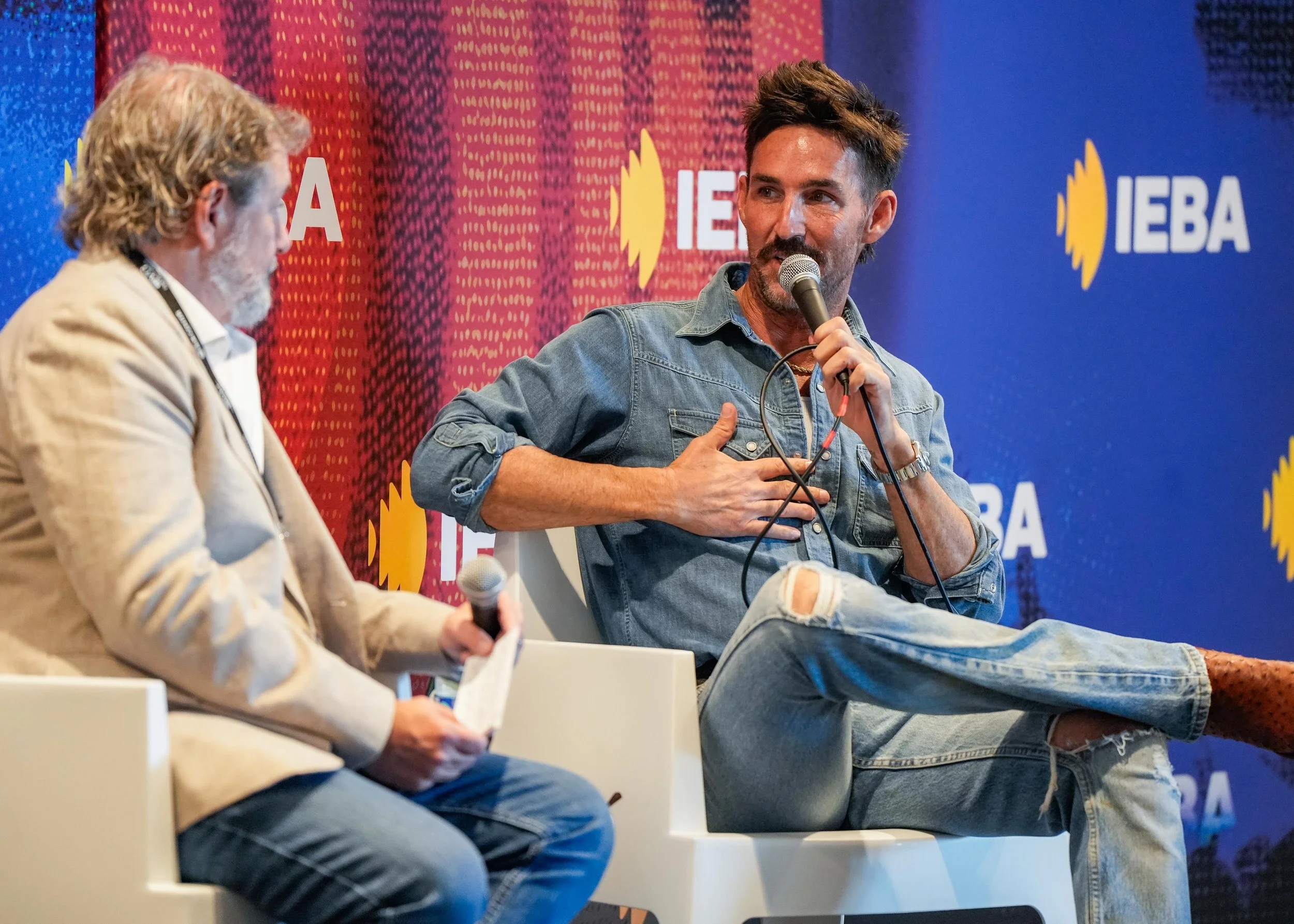
Corporate and private event buyers usually see an artist from the side of the stage. At IEBA Corporate 360, they got to hear from one directly. Jake Owen’s team at CAA introduced him as “our client, our partner and our friend,” noting that in years past this slot had featured “enthralling conversation on force majeure clauses” and “titillating conversation on private event riders.” This time, the buyers would “hear it from the artist.” Owen walked out joking that he had asked for white doves to be released when he took the stage. “So I was waiting for the doves.” Moderator Mark Letson of East Coast Entertainment, speaking to a room of corporate buyers, private event buyers, planners and agents, kept the focus on what buyers can do to make these shows work for everyone.
Winning Over the Room
Owen said his parents “knew nothing about” music, which may be why he took it up. His dad taught him golf, but when Owen played him an old Merle Haggard song, “he’s like, how do you do that?” Wanting to surprise people has stayed with him. In college, he played a fraternity hayride in a barn while cows and horses stuck their heads out into the hallway. “There’s no CEO out there that’s going to stiff me any more than a cow looking at me,” he said.
He likes rooms where nobody knows his music. “It’s the challenge to win over the room. And that’s really what you’re there for.” He described corporate shows as “an agreed hostage situation, or a hostage negotiation that I like to win every time,” and said he’ll sometimes read a guest’s name tag from the stage and call them out by name. “How does he know my name? Michelle, you’re wearing a name tag.” Those shows also put artists in front of executives who don’t know them yet, so “it’s a good way to just network and everybody wins.”
How an Offer Gets to Yes
Letson walked through how an offer reaches an artist, from the agency to the responsible agent to management, before Owen interrupted to ask what “RA” means. (“I had a resident assistant in college, who was different.”) He said every artist answers this question differently depending on where they are in life and career. With two children, his answer is different from 10 years ago. Before money, he looks at routing and the calendar. A corporate date that fits between tour stops “helps offset costs for those shows that may not be bringing in that type of money,” and can feel like magic. A one-off date is harder, even at a higher fee. Big money can be “like a dangling piece of meat in front of your face. And then your kids are pissed because you’re not at their school dance.”
Owen acknowledged that buyers get frustrated when an answer takes two weeks and comes back as a no. “We all as partners are doing our best to get you the quickest answer, and no one wants to hold anybody up.” By the time an offer reaches him, his team has already vetted it, and the decision is strategic. “It’s not just, oh, thanks for the high money offer, we’re going to grab that. We want to do great business as well.”
Tell the Artist Who’s in the Room
Asked what buyers can do to make the day easier, Owen said his own instruction to his production and tour managers is to make the buyer’s job easy, because corporate buyers often “aren’t doing this all the time.” He wants them to leave thinking, “I was so stressed out about today, and you guys came in as a group and made my life easier.” Problems happen when artists show up uninformed about who they’re playing for. Before every show, he asks his team: “Who are we playing for tonight? Tell me what they’re into, what they’re not into. Are they funny? Are they more stiff?”
He said he’d always wanted to tell buyers this: just because the CEO loves an artist doesn’t mean the room does. “There’s 800 or 1,000 people there that don’t know their music at all.” An artist who plays their usual set can leave the room feeling stiff. One who has “the freedom to do whatever you want” can bend, read the crowd and keep it fun.
Right-Size the Show
Owen offered buyers a different way to think about their offers. A $150,000 offer for an artist’s full touring production may get an instant pass, but a room of 100 people may not need it. “I want Ella Langley, I want her and her full band,” he said as an example. “You might not realize that her with her guitar player and someone else, in a very intimate setting, is going to really come across as more engaging.” It’s better for the artist too. The reverse is also a risk: an acoustic set in a room of a thousand people, with the back of the room talking, “which is their right at a corporate event.” If buyers think a venue suits a stripped-down show, he said, “you’re probably right, and never be afraid of that.” Some of his best shows came “without the whole rigmarole,” with guests in a semicircle like “a gathering around a campfire.”
Give to What the Artist Believes In
Asked what besides money would get him to take a show, Owen said a philanthropy budget can make the difference. If a company has $150,000 for entertainment and offers $20,000 to his foundation for a quick yes, “a hundred percent of the time” that gets his attention. “Sorry, Dave.” He wants to work with companies that share his values, and said the approach can work with other artists. His example was Miranda Lambert, whose love of dogs is well known: an offer that includes a gift to her dog foundation might get the response, “Damn, nobody’s ever done that.” And, he added, “you’re writing it off anyways as a donation.”
Respect, Sobriety and Showing Up Right
On what buyers may not realize affects a performance, Owen said it plainly: “Alcohol.” He’s sober now, and said there’s one corporate show from his drinking days that he still regrets. “I failed those people.” Artists need their managers and agents to make clear that a corporate show is someone else’s night. “These are people that work hard. Maybe it’s their end-of-year party, maybe they’re getting their bonuses. This isn’t about you. You don’t show up as the party. You show up to entertain the party.”
Beyond that, mutual respect matters most, and “a lot of times that does trickle from the top.” In 22 years, he said he has never had a bad experience with a corporate or private client, because they gave his team the information it needed. “Except for that one time.”
Meet-and-Greets That Feel Real
Owen said a fast photo line “still feels a little insincere” to him. “So nice to meet you. OK, you too. See you.” He’d rather do a 25-minute hang, walking around and saying hello. Not every artist will want that, he said, but “it’s not wrong of you to ask.” Nobody wants a hundred people in line, but the goal is for guests to feel they had an experience. “They don’t forget that.”
Why Professionalism Builds a Career
Asked to describe his show, Owen pointed to what people tell him afterward: that his crew was great to work with. “Everybody’s got great music. Everybody’s good. But when you can show up and be professional and do a great job, people don’t forget that. And they also recommend you to others.” His show is about “bringing people into the party, letting them forget about their life” for 90 minutes, so that when he leaves, “you wish you had 90 more.”
He has no preference between an opener and an evening on his own; it comes down to what the company wants. He shared that his girlfriend plans events for a large corporation and has told him about shows where the act “was good, but the people weren’t paying attention, and it felt a little awkward.” For an artist, he said, that’s the worst outcome. “There’s more to this than paychecks.” A guest seeing an artist for the first time doesn’t think of it as a private show. “That’s the moment they remember.”
Lightning Round and a Lesson From Kenny Chesney
In a quick round of fun facts, Owen named Hot Tamales as his current green room snack, said indoor versus outdoor depends on the time of year, and said his walk-on music changes nightly with the crowd. He always travels with his guitar. His dog used to come too, “but he’s like, no, I ain’t doing that anymore.”
Asked for his Mount Rushmore, he said there’s no manual for coming up in this business, which is why artists sometimes do things buyers shake their heads at. He was signed by Joe Galante and managed by Dale Morris and Clint Higham, and said Morris, who had recently passed away, taught him how to do it the right way after watching Alabama and Kenny Chesney do it. Owen loved Alabama as a kid and saved up to see them at the Leon County Civic Center in college. That night, Randy Owen fell ill and was carried off stage by a man who would later be Owen’s tour manager for 20 years.
He closed with a story about Chesney and George Moffett of Variety Attractions. Moffett booked Chesney early for about $5,000 a show. Years later, when Moffett called about a state fair date, he was told Chesney was now “almost a million dollars a show.” Moffett’s reply: “Well, I guess we’ll just catch him on the way down, then.” Owen’s lesson for artists: “The same people you meet on the way up are the same ones you meet on the way down.” He credited the people around him and “the way we do business” for his career, and thanked the room for a rare chance to talk about it. “There’s a lot behind this business, and I’m just happy that you could hear me out today.”
Key Takeaways
Artists weigh routing, the calendar and family before the fee. A corporate date that fits between tour stops is far easier to say yes to than a one-off.
Tell the artist who they’re playing for. Details about the crowd let them read the room instead of playing a set the audience doesn’t know.
Match the show to the room. A stripped-down set can connect better with a small group, while an acoustic set can get lost in a big one.
A donation to an artist’s foundation or cause can turn a maybe into a quick yes, and it’s tax-deductible for the company.
Corporate shows are about the guests. Artists should arrive informed, sober and ready to entertain the party, not be it.
Meet-and-greets work best as a genuine experience. It’s fine to ask for a casual hang instead of a photo line.
Professionalism and how a team treats people build a career, because the same people you meet on the way up are the ones you meet on the way down.