


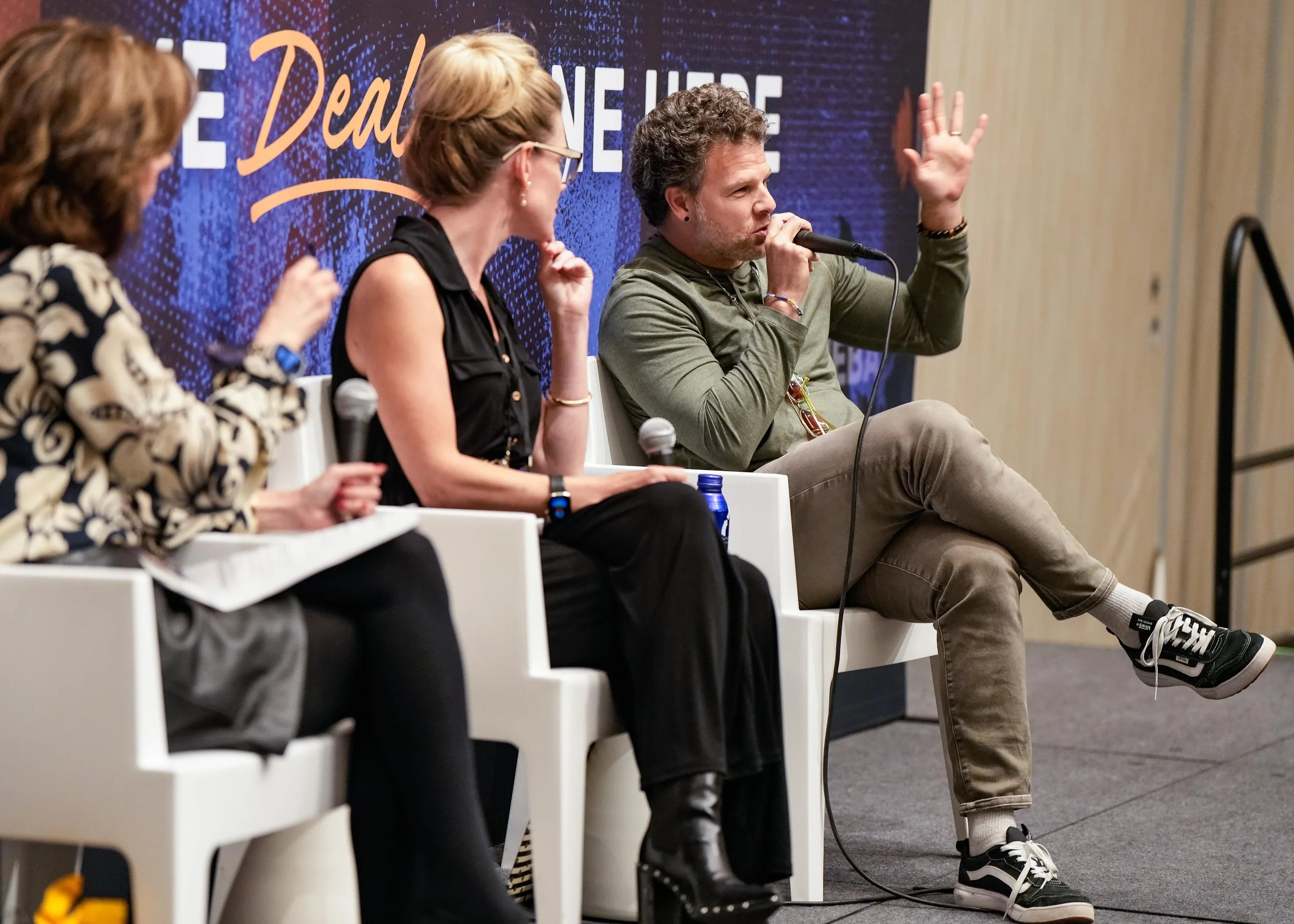
Moderated by: Debbie Carroll, Center for Mental Health In Entertainment, Belmont University
Panelists: Zach Borer, Amber Health · Elizabeth Porter, Entertainment Health Services
An IEBA board member opened the session by asking the crowd to move closer, saying she was “not alone in this room in terms of having lost friends and colleagues.” We go to the dentist every year and get checkups, she said, and “we should be thinking about our mental health in a similar way.” What the industry does “is weird, right? It’s not nine to five,” and she was proud that organizations are now forming to provide experts who understand it. Moderator Debbie Carroll picked up the theme. She has long said mental health “is a branding issue,” because it has carried negative connotations for so long, and she hopes that “at some point these rooms will be full.”
Meet the Panel
Debbie Carroll holds the CMA-endowed chair of Belmont University’s new Center for Mental Health in Entertainment, which CMA also seeded. The center rests on three pillars: community services, education for future industry leaders and for clinicians who need to learn “the nuances of entertainment,” and research to produce “solid empirical data around not only what the problems are, but what are the solutions.” Elizabeth Porter is president of Entertainment Health Services, which offers therapy alongside executive coaching to help leaders build organizations that are “more supportive to mental health needs.” Zach Borer is co-founder of Amber Health and a licensed marriage and family therapist who spent 10 years as a songwriter before becoming a therapist. Amber Health sends providers on the road and backstage at festivals and works with labels, management companies, promoters and publishers. Every member of its team comes from the music industry, because clients so often say, “Finally, somebody who understands this industry.”
What Touring Life Hides
Porter said the hardest part for many on the road is that “life doesn’t stop when they’re on tour.” Babies are born, parents die, pets get sick and children have performances, and people carry that emotional weight from afar. Borer said touring “was not designed with someone’s wellness in mind.” It runs on a 50- or 60-year-old incentive structure where “not taking care of yourself actually is the benefit”: 15- to 18-hour days away from family, heavy equipment, and a moving vehicle shared with a dozen people. “The show must go on” often means it goes on “at the expense of an individual.”
The industry now has data on the cost, he said. Among people on the road, 50% are struggling with clinical levels of depression, 38% with clinical levels of anxiety, and about a quarter report active suicidal ideation or a suicide attempt in the past year. “That’s not to scare anybody,” he said, but to show an opportunity to care for people differently, “not to make the output any less, not to start making any less money,” but to give them a safety net “so you don’t crash and burn.” Carroll said she had heard similar statistics that weekend, along with a finding that most of the same people love the work and would do it again: “You can still love what you do and still really struggle with it.”
Fear, Finances and Fatigue
Porter sums up touring stress as “the three F’s that will F you up on the road”: fear, finances and fatigue. Borer described two layers: internal struggles like family, relationships and loss, and on-the-road work dynamics. “You put two people in a room, inevitably they’re going to have some sort of conflict,” and on tour that might mean “a crew chief who maybe is old school and yells a lot.” Amber Health spends much of its road time helping departments communicate so the whole show runs more smoothly.
Asked whether the “tough it out” culture has changed, Borer said that grit is part of what makes the industry work. People in it have “insane superpowers,” and few of his clients want shorter hours. What he hears is that shows are getting bigger and routing tighter, with fewer days off, something artists and routing teams could rethink. The most common thing people love, he said, is “when those house lights go down. There’s no feeling in the world that can compare to that.” The goal is “to build better structures around them to help them do this kick-ass work.” Porter said she was never prouder of the industry than during COVID, watching executives take jobs at Target to get through, and she is optimistic that people now pair that grit with a willingness to ask for help, “as a community and not as individuals siloed in their workload.”
Making Therapy Easier to Try
Carroll frames therapy as “not necessarily that you need, but something that you deserve,” and asked what to tell someone curious but unsure where to turn. Porter compared emotions to a smoke alarm: “If you start smelling smoke, you don’t wait and see if there’s a fire.” It may be a false alarm, but emotions “are meant to be indicators,” so why struggle more than you have to? Borer sees three groups: people who will never go, people (often younger) who embrace it, and a curious middle. There is a fit for everyone, from a laid-back therapist to a direct one, to surf, art and music therapy. What matters most is an industry infrastructure that is “permissive,” where a promoter brings a provider onto a tour, therapy is free at a festival site, and a struggling crew member’s first thought isn’t “Holy shit, where do I go?”
Who Is Responsible?
Asked who is ultimately responsible for a tour’s mental health, Borer said, “It really comes down to a financial question.” Amber Health has worked about 70 tours, from single vans to the biggest stadium runs. Tour and production managers are bought in “90% of the time” because they live the 18-hour days with their crews, but adding a provider usually has to go up to the manager or artist, who may be more detached. Carroll pointed out that support doesn’t have to cost money: 12-step meetings, peer support and outside organizations are all options. Borer agreed that awareness matters. Many people don’t know grants for free therapy exist. “I’ll get you eight sessions for free, and people, their minds are blown.”
Porter added a “bystander responsibility.” If someone had a broken leg in the corner, no one would walk past. Borrowing Avatar’s “I see you,” she said people in this industry understand each other in a way outsiders can’t, and checking in can be as simple as, “Hey, your energy looks a little low today. Are you okay?” To spot someone struggling, she watches for shifts in behavior, words and beliefs, such as an optimist who suddenly sounds hopeless. On balancing compassion and accountability, she said both can exist at once: someone may need to be removed from a tour, and also asked “what do you need in that downtime to reset yourself and come back professionally?”
For leaders, Porter recommended transformational leadership built on trust, including saying “I don’t know what to do in this situation, but let’s find the resource.” She has preached the 80-20 rule for a decade: “Just expect chaos” 20% of the time. Borer said he works with A&R teams whose labels want them to recognize warning signs and know where to send people. Carroll said the responsibility ultimately belongs to everyone. “The industry talks a lot about being a family. We’re not a family, we’re colleagues,” she said, but colleagues can still have each other’s backs.
No HR on the Road
Asked what touring asks people to tolerate that no other workplace would, Borer listed the labor laws that don’t seem to apply, the patchwork of contractors and vendors paid differently for the same job, sleep deprivation, and a nervous system that spikes and crashes every night. Touring is episodic, acute and chronic stress “all the time,” which is why people so often crash, or get sick, when they get home. There are typically no unions and no HR, he said, and “no real governing body” for road workers, so Porter’s 80-20 rule is “more like a 20-80 rule on the road.” He believes change will come through peer pressure: when one big company invests in its people, others notice and call.
Small Changes That Help
Porter breaks self-care into “top down” (how your mind speaks to your body) and “bottom up” (how your body speaks to your mind). She has helped tours set up ice plunges outside the bus, collapsible bikes, a shared gym and better attention to diet and hydration. For a panic attack, she recommends holding an ice cube, which triggers the body’s response to cold water and interrupts the spiral. “Cortisol is bad,” she said, and small habits can keep it from building and help burn it off.
Borer said everyone knows the basics (eat well, exercise, maybe meditate) but drops them in the chaos of the road. Even in that chaos, people have autonomy over their feelings and perspective, which he called “quite freeing.” He also normalized anxiety: “I’m on Lexapro for my anxiety. I’m a therapist. I’m not embarrassed to say it.” From the top, he wants to close the gap between the people planning tours and those “actually pushing the cases.” His first advice to artists: “Go spend 45 minutes in catering and just say thanks for being here.” Crew “wear black, we stand in the background,” he said, but a little acknowledgment goes a long way. Carroll agreed: “All of us as humans want to be seen, valued and heard.”
The Business Case for Prevention
Should mental health planning be built into tours like security and medical? Porter said she doesn’t “love shoulds,” but it is beneficial at every level, including financially, because “turnover is expensive.” Borer said the cost of canceling a show “far outweighs” the cost of mental health services, and promoters and insurers are “undervaluing the risk.” No one hesitates to spend $120,000 to send an artist to rehab, yet prevention would cost a fraction of that. Amber Health has “saved countless shows” by sitting down with artists, dancers and crew who were ready to walk out. That work stays confidential, so “when it’s working, it’s almost invisible.” Porter added that video sessions, even “from the bathroom of a tour bus,” make support more affordable for tours.
Knowing Where to Turn
Carroll said there are more organizations in this space than ever, along with online 12-step meetings and peer groups, but more options make them harder to navigate. Know who to call before a crisis. “You don’t have to be in a crisis to get support from MusiCares or Music Health Alliance or ACM Lifting Lives,” she said, and she handed out a resource list. Porter said that, at least in Nashville, these groups refer callers to one another, so you don’t need to find the perfect fit first. Borer said the strongest predictor of success in therapy is the relationship, so callers should trust the people they reach out to. Carroll, who described calling an industry friend during her own crisis, said “healing happens in community.”
Audience Questions
Responding to audience members, Carroll said the industry as a whole, from record executives to venue staff, shows mental health statistics as stark as those for touring crews. She encouraged a group to build a cohort that proposes solutions, not just problems, to leadership. After an audience suggestion, she said she would turn the resource list into a poster for distribution, something she had done years ago at MusiCares. The Center for Mental Health in Entertainment is also planning a peer-based mentoring program. “I can’t talk to you about what it’s like to be a lighting guy,” she said, so pairing people with peers adds a unique kind of support.
Porter said the younger generation “gives me hope.” Borer described speaking to 40 engaged freshmen in a tour and festival budgeting class at UCLA whose first lecture was on the psychology of money, and said younger leaders are “more hip to this.” He knows only about 30 therapists who truly understand the industry, but more students and former industry workers are training to become clinicians. He also pointed to grassroots WhatsApp groups with thousands of touring and venue workers, including a mental health channel where people share vulnerable moments, such as anniversaries of past tragedies. Borer previewed a paper due in about six months that tracked the mental health of three major tours, and said the top-line finding is that “the most effective intervention on the road is mindfulness.”
Five Years From Now
Asked what would show the industry had become healthier, Porter said “conversation and a level of acceptance.” We don’t need all the answers, just a willingness to “have the conversation and work together and see each other.” Borer said success would mean full rooms and leaders saying, “I prioritized this, and it actually brought value to my organization.” The industry can theorize all day, he said, but it needs more case studies and “more proof of the fact that this is a worthy endeavor.”
Key Takeaways
Touring crews report clinical depression and anxiety at far higher rates than the general population, but most still love the work. The goal is better support, not less output.
Fear, finances and fatigue drive much of the stress on the road, compounded by tight routing, family life back home and no HR or unions.
Therapy is something you deserve, not just something you need. Treat early warning signs like smelling smoke.
Responsibility is shared. Tour leaders are usually bought in, budgets often sit with managers and artists, and everyone has a bystander role in checking on colleagues.
Watch for shifts in someone’s behavior, words and beliefs, and approach them with curiosity rather than a quick “you good?”
Small changes add up: ice plunges, an ice cube during a panic attack, shared exercise, mindfulness, and artists thanking crew in catering.
Prevention is far cheaper than a cancellation or a rehab stay, and video sessions make support easier for tours to afford.
Know your resources before a crisis. MusiCares, Music Health Alliance and ACM Lifting Lives refer callers to one another, and free therapy grants are available.