

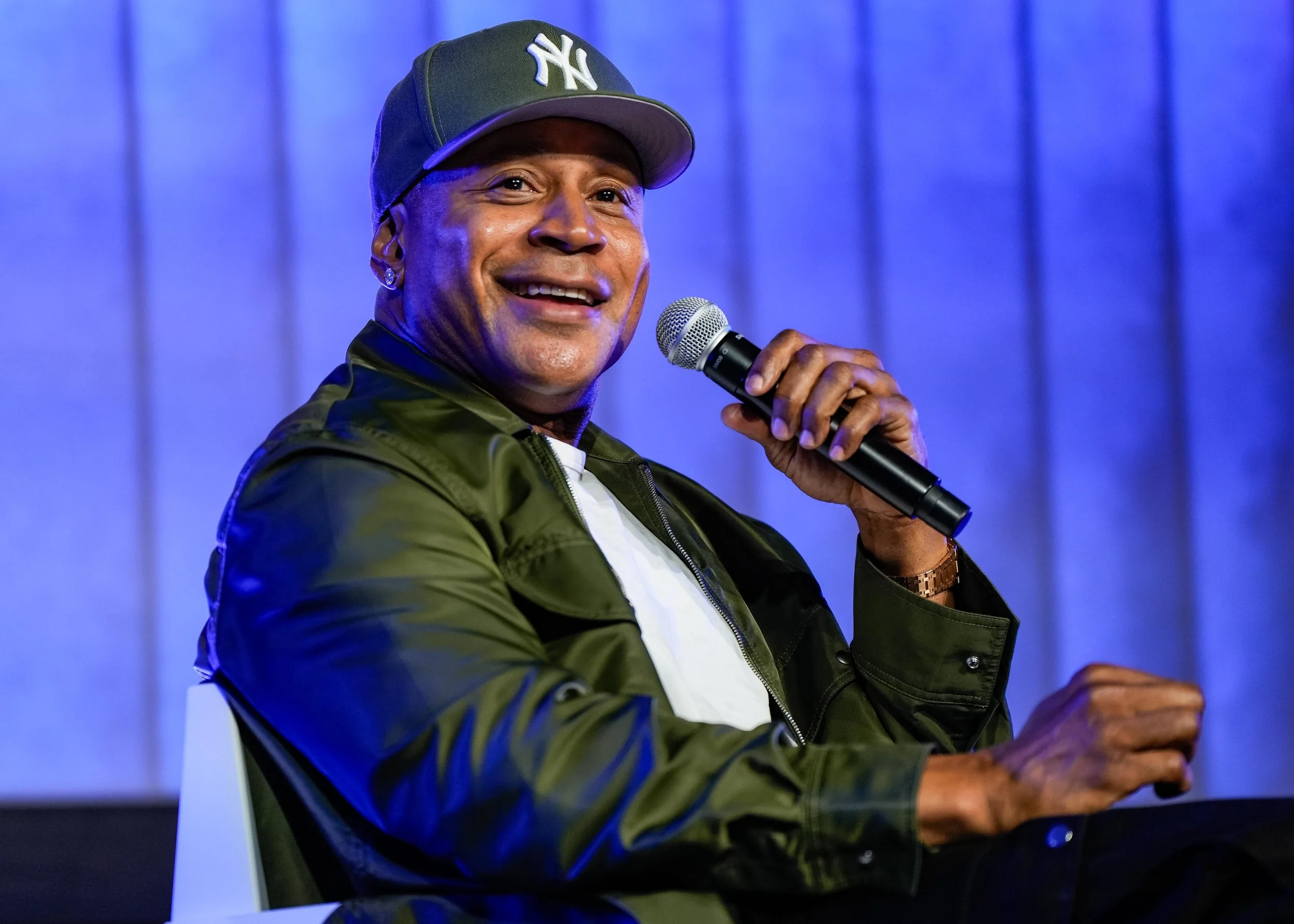
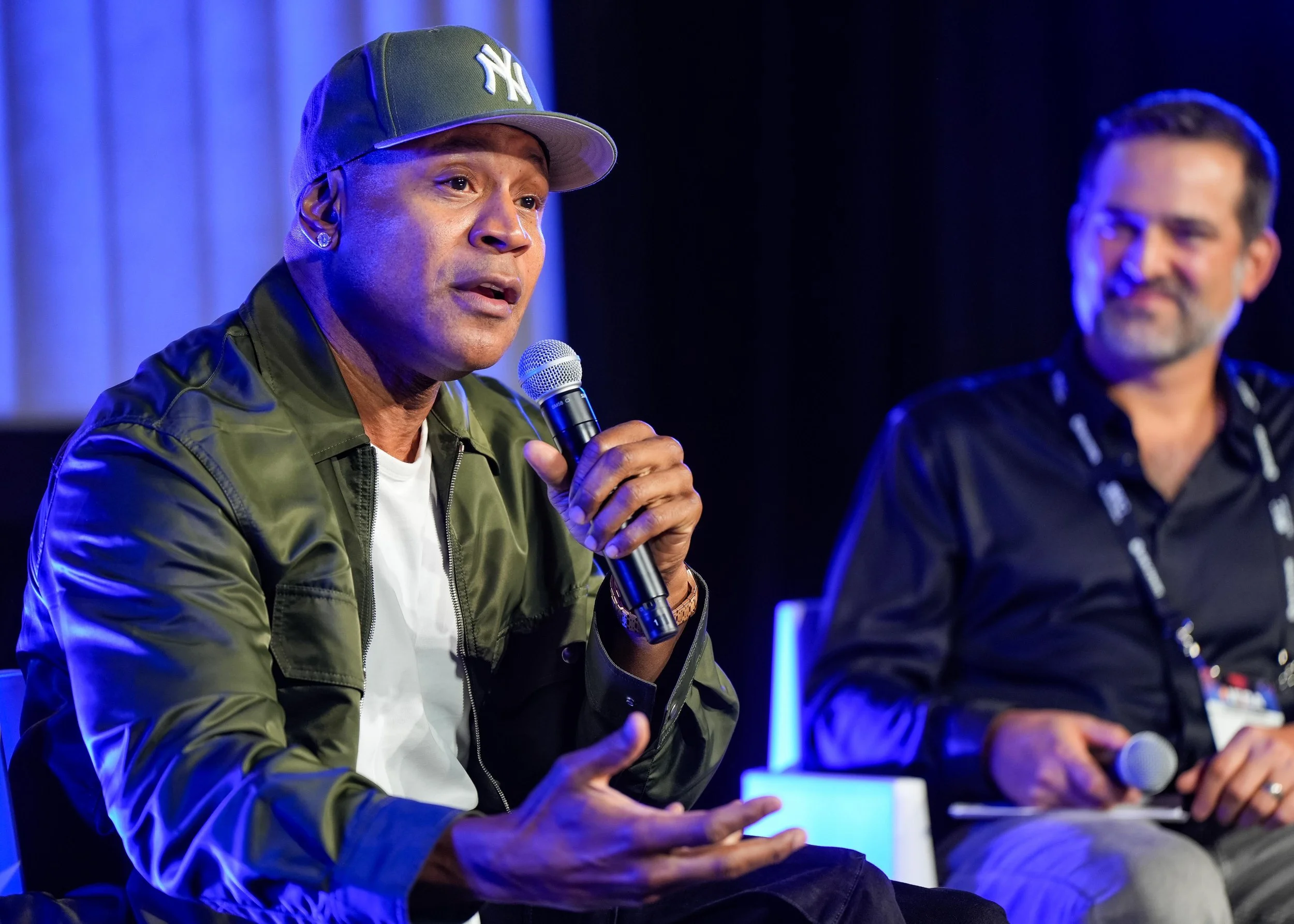
Moderated by: Jeff Cuellar, Sixthman
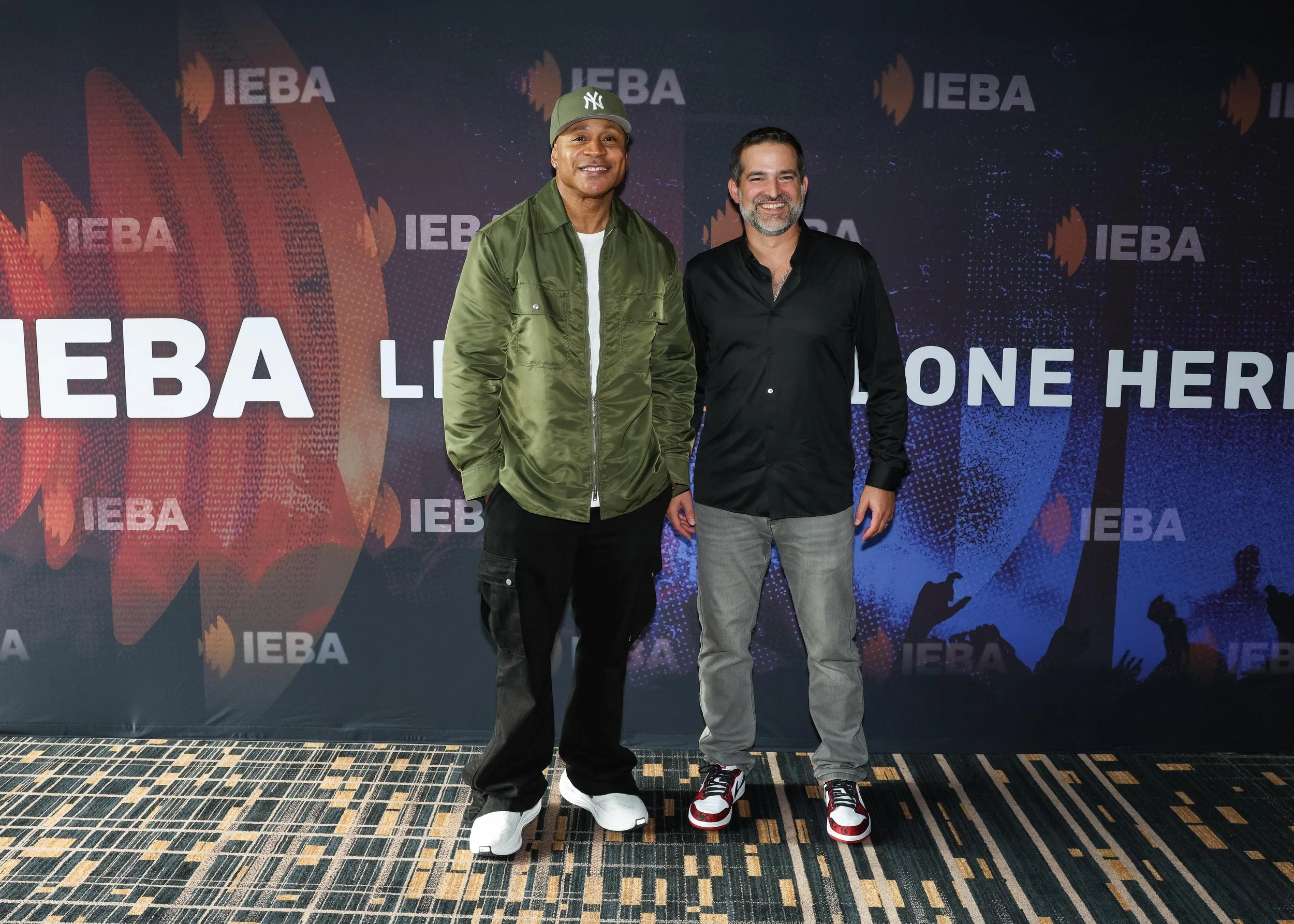
Speaker: LL Cool J, Founder, Rock The Bells
Rock & Roll Hall of Fame inductee, two-time Grammy Award winner and Kennedy Center Honoree LL Cool J took the main stage in the Grand Hyatt’s Grand Ballroom for a wide-ranging conversation with Jeff Cuellar of Sixthman, who works with LL Cool J on the Rock The Bells Cruise. “I think everyone’s quite familiar with who you are and how accomplished you are,” Cuellar said, so the two went straight to the beginning: a kid in Queens in the era of Kool Herc, Bambaataa, the Cold Crush Brothers and Wild Style, before anyone knew whether hip-hop was more than a fad.
Dreams, Demo Tapes and a $300 Drum Machine
LL Cool J said the scale of the industry never entered the picture. “You don’t think about fancy words like market share or innovator or pioneer,” LL Cool J said. “You think about, I just want to hear my song on the radio.” When a dream consumes you “to the point that you’re willing to overcommit to make it happen, good things can happen,” even with an inner voice offering “every reason in the world to stop digging three feet from gold.”
The timeline was fast. LL Cool J became a fan at 8, started writing at 11 or 12, sent out demos at 14 and at 16 became the first artist on Def Jam. After finding a crumpled rejection letter, LL Cool J’s mother used her tax refund to buy a $300 drum machine, “a huge amount of money at the time.” The demo reached Ad-Rock, Adam Horovitz of the Beastie Boys, who played it for Rick Rubin, then an NYU student in a dorm at Five University Place. LL Cool J called every day to follow up. When Rubin finally called back, LL Cool J’s grandmother mangled the name, but the meeting happened, and LL Cool J did handstands and push-ups against the pole while waiting for the E train. “And the rest is history.”
Resilience Beats the Algorithm
Asked whether today’s artists, “fighting algorithms,” still get a chance at a “Don’t call it a comeback” moment, LL Cool J was direct. “Algorithms don’t determine the vision. They may facilitate or interrupt or disrupt,” LL Cool J said, “but the reality is it’s up to you.” The one thing no one can measure is human will. “It’s incalculable, and it can smash through granite.”
The key is getting “comfortable being uncomfortable.” LL Cool J challenged the room: “What would you do if you weren’t afraid? What would you do if you knew you absolutely had a safety net? All right, now do it anyway.”
Later, LL Cool J returned to the theme. “For a setback to be a setup for a comeback is about what’s going on inside of your mind,” LL Cool J said. “Nobody came to you and knocked on your door and said, here’s your over card.” Pointing to Colonel Sanders and Ray Kroc, who built their companies later in life, LL Cool J said, “Dreams don’t have deadlines.” When people rise to the level of their incompetence, the answer is to get competent: read new books, have new experiences, and ask, “Can you be miserable for five minutes and then snap out of it and go make your dream a reality?”
Keep the Soul in Hip-Hop
Cuellar noted that hip-hop has grown from Queens and Brooklyn blocks into “arguably the biggest global language.” LL Cool J said the culture has gained great art and great points of view from artists like Run-DMC and Public Enemy, but some of the music now sounds like “talking down to people from Mount Olympus.” Hip-hop “used to be underdog music,” and it has always been “blue collar music.”
“I never cared about Bob Marley’s bank account. I never cared about Miles Davis’s bank account,” LL Cool J said. “I’m the king of capitalism. I have no problem with money.” But the art “is about soul,” about “looking people in the eye and really being able to relate to people.” The story doesn’t have to be literally true, “but let it come from a true place.”
Community is what holds it together. People bond over U2, Jimmy Buffett or Nirvana, but hip-hop is also dance, graffiti, dress, speech and “speaking truth to power.” It started in a Black community in one city, “but it’s not exclusively for that ethnicity. It’s for everybody,” LL Cool J said, noting that Ad-Rock got LL Cool J a break and Rick Rubin produced the first album. That spirit shows up on the Rock The Bells Cruise, which sells out every year and just moved to a bigger ship.
Why Rock The Bells Exists
LL Cool J said Rock The Bells came from a refusal to let hip-hop’s pioneers be forgotten. “I don’t want Melle Mel to be ignored because he’s not the most popular rapper with a 15-year-old today,” LL Cool J said. Rakim should be celebrated as a “magical lyricist,” and Big Daddy Kane as a “top-notch performer.”
The goal is to present those artists at their best, not on “a stool with a rum and Coke on it and some nasty backdrop that’s falling apart.” Having seen how Mick Jagger, Bono and the Edge are treated as they age, LL Cool J wants hip-hop artists to have “that same platform and that same level of respect as they mature.” Run-DMC, Salt-N-Pepa, Roxanne Shanté, Big Daddy Kane and Grandmaster Caz all received equity in the company. Rock The Bells Radio plays “all the timeless hip-hop” on SiriusXM Channel 43. “Instead of sitting around complaining about what people are not doing for you,” LL Cool J said, “just do it yourself.”
Next comes more live and real-time experiences, led by the Rock The Bells CEO and team. For brands, the pitch is authenticity. “If you want to connect your brand to the audience that we represent, we know how to do it in a truthful way,” LL Cool J said. “Lift up the culture, bring the community together, make it great for the brands we associate with, and everybody wins.”
Keep Your Word
Asked how to navigate consolidation, technology and politics, LL Cool J’s answer was simple. “Keep your word. Do what you say you’re gonna do.” As companies consolidate, relationships carry you. LL Cool J cited the book A Message to Garcia and added, “I don’t fall asleep in the getaway car.”
On AI, LL Cool J pointed out the contradiction of people who say they hate it and then “damn near have a relationship” with ChatGPT. “Humanity ultimately drives this train,” LL Cool J said. Inflection points are like ping-pong or handball: “You have to anticipate where the ball is going and be there ahead of time.” Stay humble, too. “When you think you know everything, you can’t learn nothing.” A cup that’s already full can’t hold more, and good advice is worth hearing no matter who delivers it. “Money doesn’t make you smart and positions don’t make you smart.”
Roots and Branches
Cuellar called LL Cool J a multi-platform brand before the term existed, from music and television to the Kennedy Center Honors, the Hollywood Walk of Fame and the Rock & Roll Hall of Fame. LL Cool J said film and TV, including the NCIS universe with an NCIS New York project coming, were less a jump than growth. “You have your roots and then you have your branches. At the end of the day, I’m just an artist.” Never limiting yourself is simple, “but simple things aren’t easy. E equals MC squared is simple.”
LL Cool J urged anyone sitting on a long-held dream to act. “Can you imagine laying there at the end and all your dreams are standing around you saying, why are you taking us with you? Set your dreams free.”
LL Cool J also turns down plenty, from endorsement offers to projects. “You can’t say yes to everything. You can’t be desperate in life,” LL Cool J said. “It’s greater later.” Some of those calls were wrong. “Of course I played myself a few times. Who doesn’t?” But there’s no room for regret. “If you knew better, you’d do better.”
The most recent album came from wanting “to prove to myself I could do it.” The Eminem collaboration “Murdergram Deux” “did really well,” and the Q-Tip-produced The Force felt like “a great contribution to hip-hop” that people will discover at their own pace. As for another battle record in the spirit of “Jack the Ripper,” “You never say never.”
Legacy Is for Others to Decide
Cuellar noted that LL Cool J asked Method Man and others about their legacy in a recent documentary. LL Cool J doesn’t spend much time on it. “When’s the last time you saw somebody pop out of a tombstone and say, no, that’s not what I meant?” Future generations will define it. “All you can do is make the biggest contribution that you can while you’re here and have fun doing it. Do the work, have some fun, have some faith.”
Advice for the Next Generation
For young people starting out on stage or behind it, LL Cool J’s advice was to know your value, keep your eyes on the prize and cherish relationships. “Treat people like you’re going to see them again,” LL Cool J said. “You can learn a lot about a person by how they treat people they don’t think they need.” And, LL Cool J joked, “maybe lay off the gold chains.”
Today’s tools matter less than how people use them. “Beethoven and Mozart didn’t have the technology that musicians have today,” LL Cool J said. Instagram, TikTok and AI are like ingredients in a kitchen, and “creativity is the winner.” Michael Jordan and Kobe Bryant weren’t the highest jumpers or best shooters, but their creativity made them magical, and they outworked everyone “at something that they had the capability to do.” For a business audience, LL Cool J tied it to strategy: it “should ladder up to the capabilities of your company,” make financial sense and survive the friction.
When Cuellar asked what the first step is for newer IEBA members still in college, LL Cool J turned it back: “What are you going to get? Know what you want. Learn everything you can about it. Then make a plan, and you’ll find out your plan is useless, but it’s a roadmap.”
Follow Through and Fill the Gaps With Good Intentions
On networking, LL Cool J said “success likes people to be outside,” and being at IEBA is already a step. The real work is follow-through. “Don’t take their number or their email and not call,” LL Cool J said. “I will take a C student with follow-through over an A student who has a thousand excuses.” Character, loyalty and being able to trust yourself matter more than looking the part.
LL Cool J also warned against filling gaps with negative stories. If your boss rushes out of a meeting, you don’t need to decide they’re unhappy with you. “Don’t fill in the blanks with a negative narrative. Allow the blanks to just live.” The same goes for replaying every conversation with someone senior. “Don’t do that. You’re fine.” Cuellar summed it up: assume good intentions.
Health, Wellness and Self-Trust
Wellness began with a look in the mirror and a decision to get in the gym. “It’s not a competition. This isn’t a beauty contest,” LL Cool J said. “You wanna be the best version of yourself.” Mental wellness comes from the same place as keeping your word: trusting yourself. LL Cool J asked the room how many believed in themselves, and said anyone who hesitated has work to do. “Nobody should walk in a room and change who you are.”
Cuellar closed with the line of the day, and LL Cool J led the room in it: “What are you gonna do? Go get it.”
IEBA President Andrew Farwell thanked LL Cool J and Cuellar, reminded attendees of the opening reception at the Pinnacle at 5 p.m., and invited everyone to the grand foyer for the ribbon cutting of the IEBA Hall of Fame exhibit, sponsored by Variety Attractions, the Oak Ridge Boys and Outback Presents.
Key Takeaways
Algorithms don’t decide outcomes. Will, resilience and getting comfortable being uncomfortable do, and “dreams don’t have deadlines.”
Rock The Bells exists to honor hip-hop’s pioneers with the platform and respect rock legends receive, including equity for artists like Run-DMC, Salt-N-Pepa and Big Daddy Kane.
Hip-hop’s strength is soul and community. Success is fine, but the music should come from a true place.
Keep your word and follow through. Relationships outlast consolidation and new technology.
Tools like AI and social media matter less than the creativity and strategy behind them.
Know what you want, make a plan, treat people like you’ll see them again and assume good intentions.